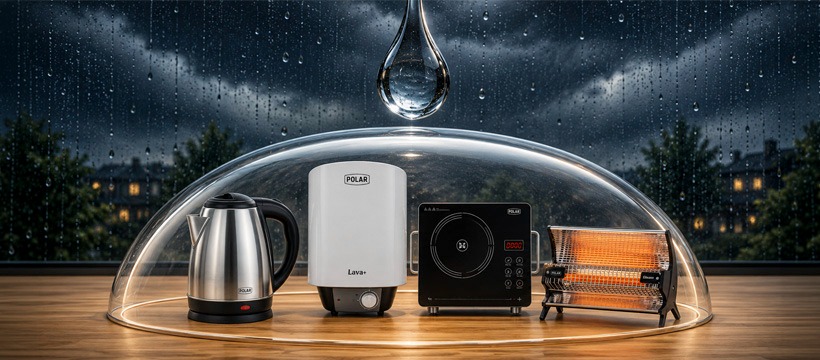
Monsoon brings welcome relief from the heat, but it also turns ordinary appliances into everyday hazards. Damp floors, humid switchboards and a little seepage near a socket are often all it takes to make a rainy evening dangerous.
At Polar, we have spent over 40 years building fans, geysers and kitchen appliances for Indian homes, and safety during the rains is something we take seriously. Here is a practical guide to using your appliances safely this season.
Why Does Rainy Weather Increase the Risk of Electric Shock?
Humidity lowers the resistance of the air and of any exposed wiring, so current leaks or arcs far more easily than in dry conditions. Damp walls, condensation inside switchboards and water creeping in near sockets all raise the chance of a short circuit. Older homes with ageing wiring are particularly vulnerable, since insulation that has worn thin offers little protection once moisture gets in.
Is It Safe to Touch Switches or Appliances With Wet Hands?
No, never touch a switch, plug or appliance with wet hands or whilst standing on a damp floor. Water on your skin sharply increases conductivity, so even a minor fault inside the appliance can deliver a serious shock. Keep a dry towel near the switchboard throughout the season, and make drying your hands a habit before reaching for any switch.
What Should You Check Before Switching On an Appliance After Rain?
Dry the appliance and its cord thoroughly, then check the plug for moisture or corrosion before switching on. Look along the cord for cracks or exposed wire, since even a hairline crack lets water in over time. If an appliance, such as an outdoor fan or pump, has been directly exposed to rain, let it dry out fully first, and when unsure, have an electrician check it rather than guessing.
How Can You Keep Extension Boards and Sockets Safe From Moisture?
Keep extension boards off the floor and well away from windows or balconies where water could pool. Choose boards with a shuttered, covered design, so dust and moisture cannot enter the socket holes when not in use. A good surge protector is worth the investment too, since voltage spikes are common when power is restored after an outage.
Should You Switch Off the Main Power If Water Enters Your Home?
Yes, switch off the mains immediately if water starts entering your home, and do not restore it until the area is dry and, ideally, checked by an electrician. Never wade through a flooded room to reach a switchboard. If you cannot reach the main switch safely, contact your local electricity distribution company or an emergency electrician instead.
Is It Safe to Use a Water Heater or Geyser During the Monsoon?
Yes, provided it is properly earthed and connected through a working RCCB, or residual current circuit breaker, which is exactly why every home should have one fitted. An RCCB compares the current flowing in and out of a circuit and trips within milliseconds if it senses a leak, well before that leak can cause a fatal shock, which matters most in wet areas like bathrooms. The Central Electricity Authority’s safety regulations require this earth-leakage protection on home circuits. If your geyser trips the RCCB repeatedly, treat it as a warning sign and have it inspected rather than resetting it and carrying on.
How Should You Handle Kitchen Appliances Like Kettles, Irons and Toasters in Humid Weather?
Wipe these appliances dry before and after use, and store them somewhere ventilated rather than in a damp cupboard, since trapped moisture encourages corrosion on the heating element over time. Never fill a kettle or use an iron with wet hands, and unplug appliances as soon as you are done rather than leaving them connected overnight.
What Should You Do If You Notice Sparking or a Burning Smell?
Switch off the mains straight away, unplug the appliance if it is safe to reach, and do not touch it again until it has been inspected. A burning smell, flickering lights or a warm switchboard are early warnings, not something to ignore until the rain passes.
When Should You Call a Professional Electrician Instead of Fixing It Yourself?
Call an electrician whenever an appliance has been submerged, whenever a breaker trips repeatedly, or whenever you are not entirely sure what caused a fault. Monsoon-related issues are rarely a one-off; they usually point to a wiring or earthing problem that will resurface with the next heavy spell. It costs far less to have it checked now than to deal with a fire or a shock later.
None of this is complicated. It simply asks for a little more care during the wettest months of the year. Dry hands, dry appliances and a reliable RCCB will see you through comfortably. At Polar, our fans, geysers and kitchen appliances are designed with Indian homes and Indian monsoons in mind, so you can get through the season without the guesswork.